

15-01-2026
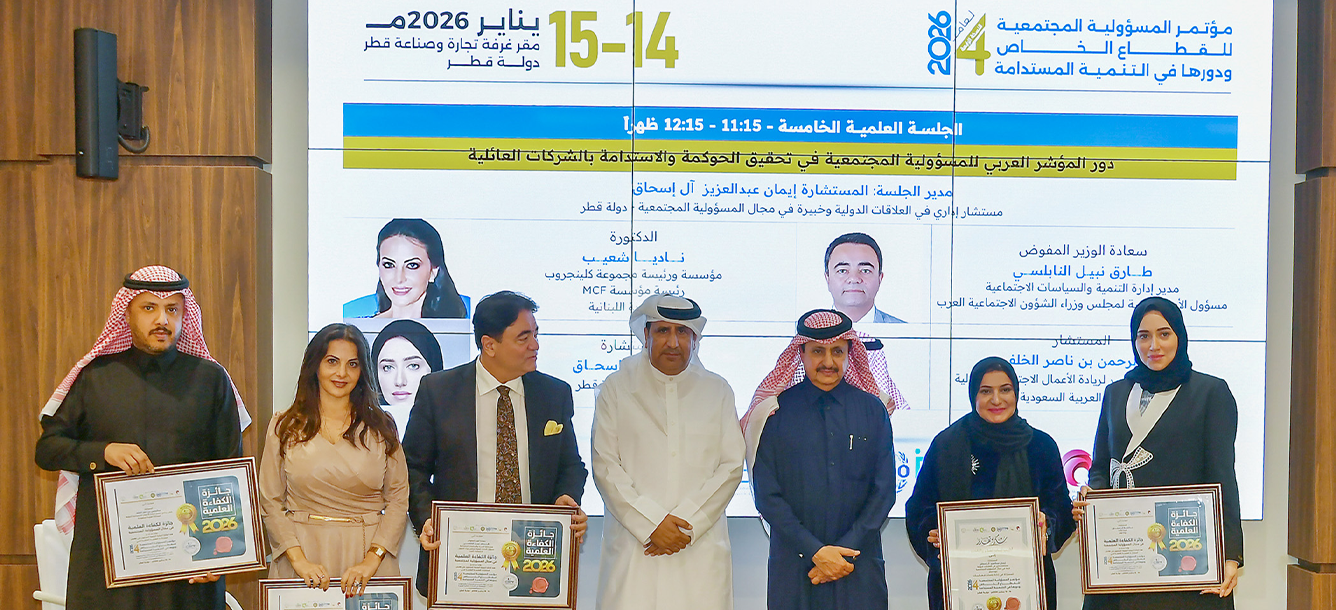
The fourth edition of the “Social Responsibility of the Private Sector and Its Role in Sustainable Development” Conference concluded on Thursday, Jan. 15, at Qatar Chamber headquarters, in the presence of Qatar Chamber Chairman H.E. Sheikh Khalifa bin Jassim Al Thani, with the issuance of a set of key recommendations.
The two-day conference was hosted by Qatar Chamber in collaboration with the Union of Arab Chambers, the League of Arab States, the Regional Network Consultancy and the United Nations Industrial Development Organisation (UNIDO).
During the conference, participants stressed that social responsibility has become a strategic pillar of good governance and a catalyst for enhancing corporate competitiveness and building trust with society. They also affirmed that the private sector is a key partner in achieving sustainable development goals.
They also stressed the importance of moving from the concept of traditional social responsibility as charitable initiatives, to an integrated model based on environmental, social and institutional governance (ESG), and compliance with global sustainability standards to ensure business continuity and enhance the competitiveness of the Arab economy.
The conference recommended the adoption of a unified professional classification for social responsibility, so that the “Arab Index of Social Responsibility” would be a reference for these practices, calling on family businesses to adopt environmental, social and institutional governance practices, and encouraging family businesses to support initiatives that enhance digital education, community health, women’s and youth empowerment, and social entrepreneurship.
It also recommended investment in artificial intelligence and green technologies to enhance efficiency and reduce the carbon footprint.
Recommendations also included launching an International Observatory for Sustainability and Responsibility, establishing professional exchange and twinning programmes, and promoting a culture of social responsibility for new younger generations.
The conference’s recommendations constituted an integrated roadmap combining the unification of social responsibility standards, the governance of global value chains, the enhancement of institutional flexibility and social innovation, investment in sustainable digital transformation, and the promotion of green finance. They also emphasised empowering new generations and organising leadership transitions in family businesses.
The conference further highlighted the principle of human solidarity, calling for the establishment of joint Arab funds and initiatives to support research, development and digital entrepreneurship.
Therefore, the Doha 2026 Declaration represents a collective commitment by the private sector and international partners to translate these visions into practical policies and formulate a new social contract linking profitability with responsibility, growth with sustainability, to ensure a more balanced and just future for coming generations.
It also represents a step towards formulating an Arab model of social responsibility capable of aligning profitability and sustainability, promoting social innovation, stimulating green finance, and empowering a new generation of leaders in family businesses.
Discussions focus on new generations in family businesses, innovation, disclosure, governance and sustainability
The first day’s second session, entitled “New Generations in Family Businesses Lead a Transformation Towards Sustainability,” was chaired by Advisor Maryam Mubarak Al-Ateeq Al-Dosari, a sustainability expert in the State of Qatar. The session highlighted the pivotal role of new generations in driving sustainable transformation within family businesses.
The panel featured H.E. Mr. Hamad Zaid Al-Basis, Chairman of Al-Awazem Charitable Foundation and UN Ambassador for Community Partnership in the State of Kuwait; Ms. Lulwa Nasser Al-Yazidi, Director of the Community Awareness Department at the Family Consulting Center (Wefaq) in the State of Qatar; Mr. Afif Barhoumi, Investment Promotion Expert at the Investment Promotion and Technology Office (UNIDO) in the Kingdom of Bahrain; Eng. Khaled Abdulrahman Al-Othman, Chairman of the National Committee for Sustainability and Green Economy in the Kingdom of Saudi Arabia; and Mr. Ahmed Al-Yasiri, Advisor to the Federation of Iraqi Chambers of Commerce, Training Expert at the International Finance Corporation (IFC), and Secretary-General of the Chambers of International Commerce in the Republic of Iraq.
While the third session, entitled “Social Innovation in Social Responsibility Initiatives in Arab Family Businesses,” was chaired by Ms. Malak Al-Hout, Program Director at the Makhzoumi Foundation in Lebanon.
The panel featured H.E. Dr. Salah bin Ali Abdulrahman, former Minister, Parliamentarian, and President of the International Congress on Social Responsibility in the Kingdom of Bahrain; H.E. Brigadier General Dr. Ibrahim Mohammed Rashid Al-Samih, Director of the Community Police Department at the Ministry of Interior in the State of Qatar; Mr. Fathi Abdulwasi Hael Saeed, Regional Director for Kenya and East Africa at Hayel Saeed Anam & Partners Group in the Republic of Yemen; Mr. Samer Al-Safah, Director General of the Makhzoumi Foundation in Lebanon; and Mr. Salem Bahmam, Vice Chairman of the Regional Training Network Institute in the Kingdom of Saudi Arabia.
The fourth panel, entitled “Transparency, Disclosure, Trust Building and Their Applications in Arab Family Businesses,” was moderated by Dr. Rawda Al Qubaisi, an academic and human resources expert in the State of Qatar. The session featured a group of speakers, including Dr. Maysar Siddiq, businessman and UN Ambassador for Community Partnership in the State of Qatar; Dr. Sarah Al-Jazzar, Senior Economic Advisor at the Federation of Arab Chambers and Dean of the Faculty of International Transport and Logistics at the Arab Academy for Science, Technology and Maritime Transport in the Arab Republic of Egypt; Professor Alexander Nehme, Owner and CEO of Herbatica in Lebanon; and Professor Dr. Ali Abdullah Al Ibrahim, General Manager of the Regional Consulting Network in the State of Qatar.
While the fifth session was entitled “The Role of the Arab Social Responsibility Index in Achieving Governance and Sustainability in Family Businesses”. Moderated by Advisor Iman Abdulaziz Al Ishaq, Administrative Advisor in International Relations and Expert in the Field of Social Responsibility in the State of Qatar, the panel featured speakers, H.E. Minister Plenipotentiary Tariq Nabil Al Nabulsi, Director of the Development and Social Policies Department and Head of the Technical Secretariat of the Council of Arab Ministers of Social Affairs; Dr. Nadia Shoaib, Founder and President of Clingroup and President of MCF Foundation in Lebanon; Counselor Abdul Rahman bin Nasser Al-Khalaf, Head of the «Jisr» Program for International Social Entrepreneurship in the Kingdom of Saudi Arabia; Counselor Aisha Al Ishaq, financial expert in the State of Qatar.
The sixth session, entitled “The Importance of Partnerships between Arab Family Businesses for Development,” was moderated by Mr. Yousef bin Mohsen Al-Lamki, President of the Rabat Center for Initiatives and Social Responsibility in the Sultanate of Oman. The session featured a distinguished group of speakers, including H.E. Dr. Ibrahim Al-Dakhiri, Director General of the Arab Organization for Agricultural Development in the Republic of Sudan; Dr. Salah Al-Haboub, financial expert and member of the Sudanese Financial Professionals Association in the State of Qatar; and Dr. Shehab Ahmed Al-Othman, Director General of the Institute of Superior Achievement for Training and Consulting in the State of Kuwait.